Document preparation / Birth certificates
Birth certificate translation: a preparation checklist
Prepare a birth certificate for translation with an illustrated scan check: include edges, reverse-side notes and readable seals, then confirm recipient requirements.
A birth certificate translation starts with two checks: do you have the right version of the certificate, and what does the receiving authority require? Then provide a readable copy of every page, including any text on the reverse, and agree on the translation language, certification, and delivery format before work begins.
This guide is for people preparing a foreign-language birth certificate for an application in the United States, United Kingdom, or Canada. It offers a document-preparation process; the institution handling your application determines which records and translation arrangements it accepts.
Check the certificate before ordering
A translation cannot turn the wrong record into the right evidence. Find the checklist for your specific application and confirm whether it asks for an original certificate, a certified copy, an extract, or a particular version of the record. If the wording is unclear, ask the receiving institution before paying for translation.
For example, the U.S. Department of State’s immigrant visa civil-document stage asks applicants to obtain an original birth certificate or certified copy and directs them to country-specific document guidance. That is a requirement for that process, rather than a rule for every use of a birth certificate. Department of State civil-document guidance.
For Canada, requirements depend on the application. For example, IRCC’s guide for sponsoring a spouse, partner or dependent child describes English or French translations, a translator affidavit when the translator is not a Canadian certified translator, and source-copy requirements subject to the application checklist. Its translator-eligibility rules also exclude applicants and their family members. Check the current guide and country-specific checklist for that program; these instructions should not be assumed to cover every IRCC application. IRCC Guide 5289.
Keep these questions beside your application checklist:
| Question | Information to record |
|---|---|
| Who will receive the document? | The institution and application or reference type |
| Which certificate version is requested? | The exact wording from its checklist |
| Which language is required? | English, French, or another stated language |
| What must accompany the translation? | Certification, affidavit, certified copy, or other specified item |
| How will you submit it? | Upload, printed copy, or another stated format |
Save the requirement link or relevant instructions. Sharing them with the translator is more useful than saying that you need an “official translation.”
Make a readable, complete source copy
Lay the certificate flat and capture the whole page. A scan is useful when available; a photograph can also work if the text is sharp and nothing is cropped. Check the image at a readable size before sending it.
- Include all four edges and any attached continuation pages.
- Capture the reverse when it contains writing, stamps, or annotations.
- Avoid fingers, shadows, glare, filters, and objects covering the text.
- Check small print, registration numbers, marginal notes, and seal text.
- Keep pages in order and identify which files belong to the same certificate.
Do not retouch a name or remove a note to make the image cleaner. If a line is blurred or damaged, provide a better copy or tell the translator about the problem. A translator should identify unreadable content instead of guessing what the certificate says.
Compare the capture with the complete record
Fictional preparation example: the diagram below uses invented record shapes and labels, with no personal data or official certificate design. It shows three different capture problems; none can be fixed by guessing the missing text.
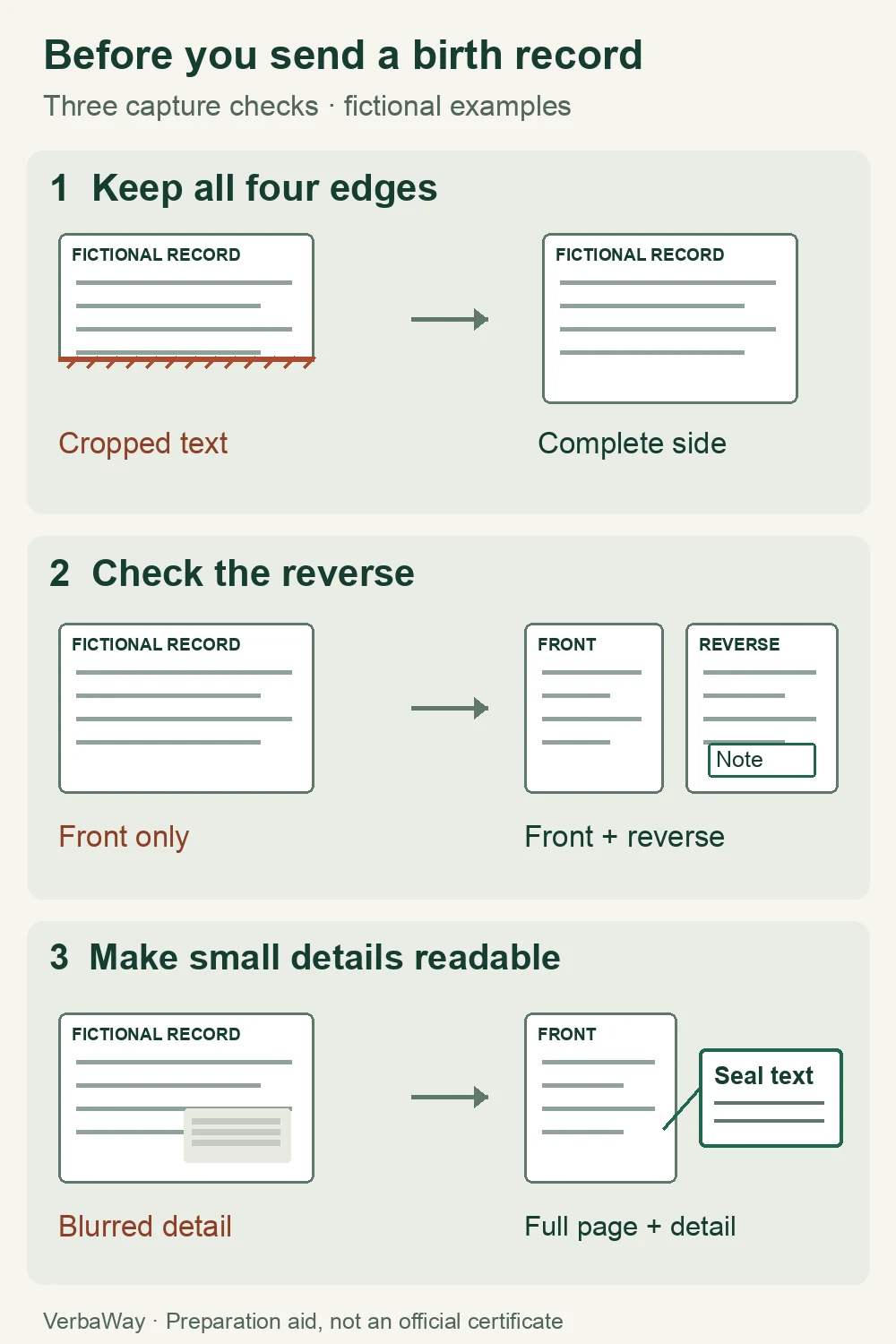
| What you notice | What to provide or ask |
|---|---|
| A line or page edge is cut off | Recapture the entire side with all four edges visible. Compare the new image with the physical record before sending it. |
| The reverse contains a note or stamp | Capture that side too and keep it paired with the front of the same record. Do not assume a front-only image is complete. |
| Seal text is too faint or blurred to read | Try a clearer capture. If useful, add a close-up alongside the whole-page image, keeping both identifiable as the same record. If the physical record itself is unclear, flag it rather than editing or reconstructing the text. |
A close-up supplements the complete page; it does not replace it. Before requesting a quote, tell the provider which files show the front, reverse and any supplementary detail. The receiving institution still decides which source record and submission format it requires.
For a document going to United States Citizenship and Immigration Services (USCIS), the governing translation rule calls for a full English translation and certification of completeness, accuracy, and translator competence. Read the focused USCIS translation requirements guide for the distinction between this rule and a general request for certification. 8 CFR 103.2(b)(3).
For a National Visa Center civil-document package, check the NVC language rule and source/translation upload checklist alongside the instructions for your interview post.
For the UK Ukraine Permission Extension scheme, use the UPE document and translation checklist to distinguish child and family evidence from records that may be requested later. That route-specific guide helps you establish the task before using the general preparation steps here.
Flag names and dates without changing the record
Names can appear differently across a certificate, passport, and application form. A second given name might be abbreviated on one record; a name written in Arabic or Russian may have more than one Latin-script spelling. Provide an existing passport spelling as a reference and identify any difference explicitly.
An illustrative note might say: “My passport uses Elena Petrova. The certificate has a longer patronymic name. Please retain the information on the certificate and tell me how the difference will be shown.” This gives the translator context without asking them to rewrite the source.
Dates need the same care. If a number could mean 4 May or 5 April, point out the ambiguity. Ask for a clear rendering where the source permits it. A translation should reflect the certificate; correcting the underlying record is a separate issue for the issuing authority.
Agree on certification and delivery
Certification describes the translator’s statement about the translation. A certified copy concerns a copy of the source document. Notarization concerns a notarial act, whose meaning depends on the jurisdiction. These can appear in the same application bundle, but they are separate requests. Our certified versus notarized translation guide explains the distinction and provides a worksheet for confirming apostille and translation order with the relevant authorities.
For a UK submission, GOV.UK’s general guidance asks the translator to provide written confirmation of accuracy, the translation date, and their full name and contact details. Always check the particular receiving body as well. GOV.UK guidance on certifying a translation.
Ask the provider to confirm what the quote includes: the translation, certification statement, output format, any printed copies, and any separately requested formalities. Confirm the delivery date against your application deadline rather than assuming a standard turnaround. When comparing providers, use the quote calculator and printable scope worksheet with the same certificate pages and required arrangements.
Review the finished package
Compare the source and translation side by side. You do not need to be able to assess every translated sentence to spot a missing page or mismatched reference number.
- Check that each source page has a corresponding translation.
- Compare names, dates, places, and registration numbers.
- Look for the treatment of stamps, notes, and unreadable text.
- Confirm that the certification refers to your document.
- Check the requested delivery format and any additional source-copy requirements.
Send a clear correction request if something differs: identify the page, field, and issue. Avoid editing the translator’s completed PDF yourself, because its certification relates to the version they prepared.
Questions people ask
Can I translate just the main fields? A few translated fields may be useful for personal understanding, but they are different from a full translation for an application. Follow the receiving authority’s instructions; for USCIS, the rule requires a full translation.
Does every birth certificate need notarization? Check the institution’s exact requirements. A request for a certified translation alone does not establish that a separate notarial act is needed.
What if I only have a poor photograph? Send the available copy for assessment and explain whether you can obtain a scan or replacement. Do not approve guesses about unreadable details.
Use the printable document-preparation checklist to keep the source pages, destination instructions and delivery questions together. The certified translation service page explains what to clarify when discussing the scope of your order.
Ready to prepare your document? Request a translation quote with the certificate, language pair, receiving institution, and requirement link. Those details make it easier to establish the correct scope before translation begins.
Ready to request the translation? Review VerbaWay’s birth certificate translation service for the quote, certification and delivery details to confirm before ordering.
Sources checked on . The cited requirements apply to the named institutions and processes. Recheck your recipient’s current instructions.