Translation quotes / Costs
Certified translation cost: compare the scope, not just the price
Compare two certified translation quotes with a private calculator, billable-page example and printable scope worksheet. Use your own rates and counting rules.
Certified translation cost depends on the work being quoted: document length and legibility, language pair, formatting, required certification or other formalities, delivery, and deadline. Compare quotes for the same package, and ask how the provider counts pages or words before choosing on price alone.
This guide helps individuals requesting quotes for certificates and other official documents. It gives you a quote calculator and printable scope worksheet. The calculator uses your figures; it does not supply VerbaWay rates or a claimed market average. A reliable total requires the actual files and requirements.
Choose your starting point: compare two quotes in the calculator if you have confirmed word counts and rates; use the scope worksheet for flat fees or different pricing methods. Need a price for your own documents? Request a quote with the complete files and recipient’s instructions.
Understand the unit behind the price
The American Translators Association explains that translation may be priced by words, characters, pages, a flat fee, or time, depending on the work. It also describes how document format, length, official certification, deadline, language combination, and subject matter can affect a quote. These are factors to check, not a universal pricing formula. ATA’s guide to translation costs.
If a provider advertises a per-page rate, ask what a billable page means. Is it one physical side of the source, a maximum amount of text, or another defined unit? If pricing is by word, ask which document’s word count is used and how stamps or handwritten entries are treated. For a flat quote, confirm precisely which files it includes.
A short certificate can contain small print, annotations, and multiple languages. A page count alone may not describe the complete scope. Sending the files helps the provider see those details before committing to a total.
For a university application, use the diploma and transcript preparation guide to identify the requested records, grading key and relevant pages before comparing quotes.
Work out the billable pages before comparing rates
A physical sheet, a scanned PDF page and a billable translation page can be different units. Ask for the provider’s definition and its counting method, including whether partial units are rounded separately for each document or across the whole order. Do not assume that merging PDFs changes how the work is billed.
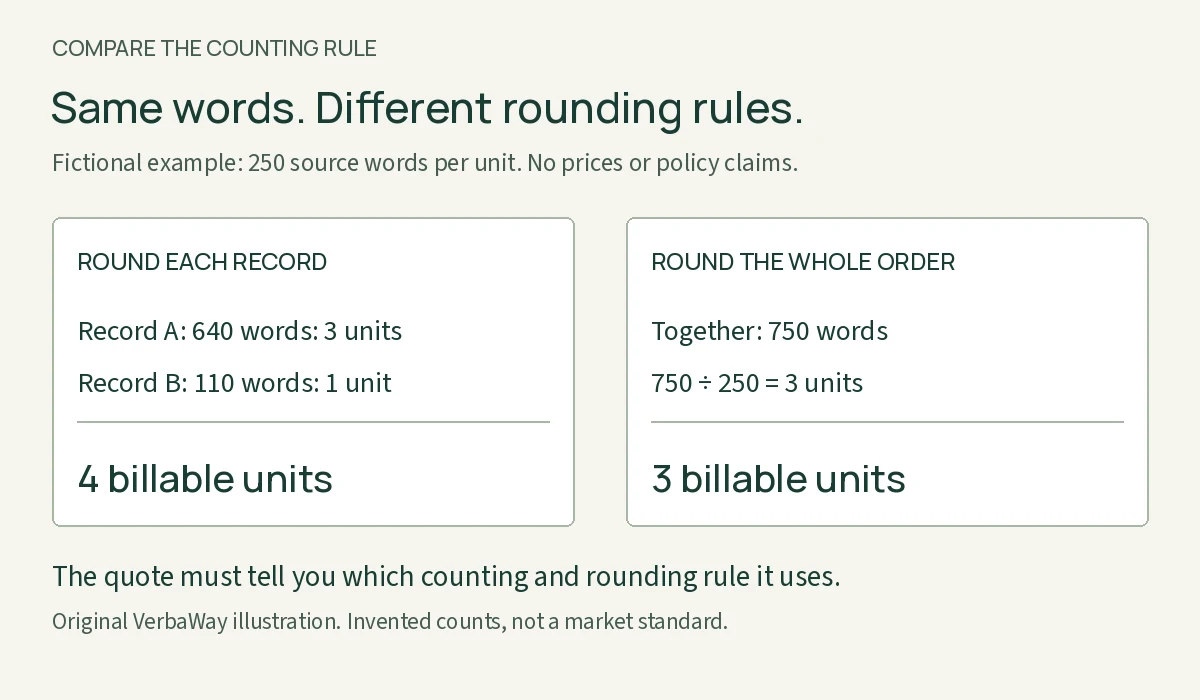
Fictional counting example — not VerbaWay’s pricing policy or a market standard. Imagine a quote defines one billable page as up to 250 source words and rounds each document up to a whole unit. The counts below are invented for this example; the provider must confirm the actual count, including how numbers, stamps and annotations are handled.
| Record | Example source words | Billable units under this fictional rule |
|---|---|---|
| Record A, including its reverse | 640 | 3: two full units and one partial unit |
| Record B | 110 | 1 partial unit |
| Complete order | 750 | 4 when each record is rounded separately |
Dividing the combined 750 words by 250 gives three units. That would describe a different rule: counting and rounding the whole order together. Neither method can be assumed from the phrase “per page.” Ask the provider to show the count used in its quote before multiplying by an advertised rate.
A minimum charge creates another question: does it apply once to the project, to each document, or to another specified part of the work? Ask whether it replaces a smaller calculated charge or is added separately. An agreed written total resolves these differences better than estimating from a headline rate.
Use these three checks:
- Match the counted records and sides to the files you sent.
- Confirm the billable unit, rounding and minimum-charge rules in that quote.
- Compare the final amount for the same agreed translation, certification and delivery package.
These checks extend ATA’s explanation of pricing units and minimum service charges with an original calculation. They do not establish a universal formula or a VerbaWay rate.
Calculate two quotes with your own figures
Enter the same records for both providers, then use each quote’s confirmed unit, rate, counting rule and charges. For per-word pricing, enter 1 word per unit. For a defined billable page, enter the quoted words per unit. Only compare amounts in the same currency; this tool does not convert currencies.
Your figures. A clearer comparison.
Compare two translation quotes
Use the same records and currency for both quotes. Enter only counts and quoted charges; no names or document text. Entries stay in this page, are not saved or sent to analytics, and clear when you reload. If you allow analytics, we count completed comparisons and clicks to the worksheet or quote form, without collecting your figures.
- Gather the figures. You need each record’s word count, both quoted rates and their counting rules.
- Enter both quotes. Leave optional charges blank only when none apply; confirm any unknown charge with the provider.
- Check the scope, then calculate. Compare the written totals and included work before deciding.
Have flat fees, physical-page prices or no confirmed word counts? Use the scope worksheet instead. For a price on your own files, request a VerbaWay quote.
No comparison calculated.
Next: check the included-work worksheet, or request a quote for your documents. Calculator entries are not transferred to the quote form.
How this works: divide each record’s words by the quoted unit and round up, or pool the words and round up once. Multiply units by the rate, round each calculated group to the nearest cent (half up), apply the selected minimum rule, then add other charges. A per-record minimum requires a per-record breakdown. Blank optional amounts mean zero. No exchange rates, percentage taxes or unlisted fees are added. Ask for the provider’s written total if its counting, rounding or tax rules differ. A flat-fee quote can be compared with the worksheet below.
This is arithmetic using your inputs, not a VerbaWay price, market estimate, acceptance prediction or provider recommendation. Confirm the final payable amount with each provider.
Use the worksheet below to check what the totals actually include. If either provider uses a different formula, charges by physical pages or hours, or offers a flat price, compare its confirmed written total with the worksheet instead.
Use a quote comparison worksheet
Print this worksheet alongside your calculation. Write each provider’s answer under Quote A and Quote B; mark missing information before deciding. Jump to the calculator.
| Item | Question to ask / Quote A / Quote B |
|---|---|
| Source files | Does the quote include every page, reverse side, and attachment? A: ______ B: ______ |
| Languages | Which source-to-target language direction is quoted? A: ______ B: ______ |
| Price unit | Is the charge per word, defined page, document, or project? A: ______ B: ______ |
| Minimum charge | Does it apply per project or per document, and how is it included in the total? A: ______ B: ______ |
| Translation | What formatting and review are included? A: ______ B: ______ |
| Certification | Which statement is included, and who signs it? A: ______ B: ______ |
| Other formalities | Is an explicitly required affidavit, notarial act, or source-copy service included? A: ______ B: ______ |
| Delivery | What electronic or printed output will you receive? A: ______ B: ______ |
| Deadline | Is the delivery date agreed, and does it affect the price? A: ______ B: ______ |
| Final amount | What currency, taxes, delivery charges, and other charges apply? A: ______ B: ______ |
| Corrections | What happens if a translation error is identified? A: ______ B: ______ |
Not every project needs every item. Mark a formality as required only when the receiving institution asks for it. If a provider cannot supply a requested arrangement, establish that before paying rather than assuming it comes with “certification.”
Certification and other formalities need clear scope
A signed statement about a translation, a translator’s professional credential, a certified source copy, and a notarial act are different things. Asking for “everything official” makes it difficult to know what the quote covers. Our certified versus notarized translation guide helps separate these requests.
For instance, a USCIS submission has a specific translation and certification rule. It is more precise to share that requirement and the form instructions than to order notarization by default. See the USCIS translation requirements guide and 8 CFR 103.2(b)(3).
For another destination, provide that institution’s actual requirements. Do not use one country’s certification package as an assumption for every application.
Preparing a New Zealand Visitor Visa file? Use the visitor translation file checklist to identify the package before comparing quotes.
An illustrative comparison
Suppose you need a two-sided certificate translated into English. The front is printed clearly; the reverse has a handwritten registration note. One quote includes only the front and a PDF translation. Another includes both sides, a translation certification statement, and printed delivery.
The totals cannot be compared fairly until both providers quote the same scope. Ask for both sides to be assessed, clarify whether printed delivery is needed, and establish the required certification. This example contains no market price: its purpose is to show why a lower headline amount can describe less work.
For a birth certificate or marriage certificate, the preparation checklists help identify reverse-side entries and related records before you ask for pricing.
Make your quote request useful
You can adapt this original request:
Please quote for the attached document, including the front, reverse, and any continuation pages, from the source language into the required target language. It will be submitted to the named institution for the stated purpose. I have included its requirements. Please confirm the full scope, certification arrangements, output format, delivery date, currency, and total charges before work begins.
Add the actual deadline. A deadline for submitting an application is different from the date you need the translated package in hand. Leave time to check the files and resolve any questions; ask the provider what delivery is available rather than assuming a rush option.
The certified translation service overview explains which details to confirm about the work and delivery. The document-preparation checklist helps organize the inputs for a comparable quote.
Questions people ask
Why can’t an exact price always be given from a page count? The files may reveal handwritten text, dense content, additional languages, annotations, or a required output that the count alone does not describe. Ask what information the provider needs to confirm the quote.
Does combining two records into one PDF reduce billable pages? Not necessarily. The provider may count and round each underlying document separately. Keep the records clearly identified and ask how the order is counted; do not omit required pages to reduce the apparent file count.
Should I pay for notarization to be safe? First establish whether a notarial act is required. An extra formality is not a substitute for a complete translation or the correct source record.
Is the cheapest quote necessarily poor quality? A price alone does not demonstrate quality. Compare the scope, qualifications relevant to the requirement, communication, deliverables, and correction arrangements. Avoid assuming either a low or high price guarantees acceptance.
Ready to compare a defined package? Request a VerbaWay quote with the complete files, language pair, receiving institution’s instructions, and deadline. Confirm the scope and total before approving the work.
Sources checked on . The cited requirements apply to the named institutions and processes. Recheck your recipient’s current instructions.