Certification / Examples
Translation certification statement: an annotated example
Review a translation certification statement: check USCIS declarations, distinguish practical fields, and match the signer and statement to the final translation.
A translation certification statement identifies a translated document and records the signer’s declarations about it. For a document submitted to United States Citizenship and Immigration Services (USCIS), the relevant rule requires certification of a full English translation’s completeness and accuracy and the translator’s competence for that language direction. 8 CFR 103.2(b)(3).
The original example below helps you understand those declarations. It is an illustration, not an issued certificate or a government-approved form. The person making the statement must truthfully describe the work they translated or reviewed and their competence. The package must meet the receiving institution’s instructions.
An illustrative statement for a source-to-English translation
The fields in braces are deliberately unfilled. A completed statement must refer to the actual translator and document; the reader should not sign on another person’s behalf or claim a competence they do not have.
TRANSLATOR'S CERTIFICATION

Translator: {full name}
Source language: {language}
Target language: English
Document: {title, issuing authority, and identifying reference}
Source pages covered: {page count or identified pages}

I am competent to translate from the source language stated above
into English. I certify that the accompanying translation of the
identified document is complete and accurate.

Translator's signature: ____________________
Date: ____________________
Contact details: ____________________
This wording is offered to explain the declarations, not to assert that it satisfies every authority’s preferred form. If the recipient provides a mandatory statement, prescribed form, signature method, or translator-eligibility requirement, use those instructions. Do not assume that adding more impressive language creates a stronger certification.
Confirm whether the signer translated or reviewed the work
The American Translators Association’s U.S. guidance distinguishes a person certifying their own translation from a person certifying work they have fully reviewed for accuracy and completeness. It advises the statement to identify which role the signer performed, and the reviewed translation must not be changed after certification. This is professional guidance; the receiving institution’s signer-eligibility and filing instructions still control your submission. ATA guidance on certification statements and signer roles.
Ask the provider: “Who will sign, and did that person translate or review this version?” If the stated role does not match the work performed, ask for it to be clarified before submission. A company name or a professional credential does not answer that question. The illustrative wording above explains the declarations; it does not establish that a particular signer is eligible for every recipient.
What each part does
| Part | What to check | Requirement or review aid? |
|---|---|---|
| Translator’s name | A real identifiable signer rather than a generic company label | Identification recommended in ATA’s statement guidance; check the recipient’s prescribed fields. |
| Source and target languages | The languages match the actual document and translation | The labels help connect the required competence declaration to the actual direction. |
| Document reference | Title and identifying details correspond to the source | Document identification recommended by ATA; it helps associate the statement with the work. |
| Pages covered | No source page or written side is left unexplained | A practical scope check supporting full translation, not a prescribed page-count field in the USCIS provision. |
| Competence declaration | The signer’s declaration concerns the actual source-to-English direction | Expressly required by the cited USCIS translation provision. |
| Completeness and accuracy declaration | The declaration concerns the accompanying translation | Expressly required by the cited USCIS translation provision. |
| Signature, date, and contact | The completed statement follows the recipient’s format | ATA recommends name, signature and date. Check the recipient’s contact and signature requirements separately. |
The table separates 8 CFR 103.2(b)(3)’s declarations from ATA’s professional statement guidance and practical document checks. It is not permission to omit identifying information or ignore a prescribed form. A particular recipient may require additional fields or a specific signature method.
Check what the statement actually declares
Fictional wording for review: “I confirm that this translation is accurate.” If this is the statement’s only declaration, it leaves completeness and the translator’s source-to-English competence unstated. A heading such as “Certificate of Accuracy” does not supply those missing declarations.
Compare it with this illustrative excerpt, assuming a Spanish-to-English translation:
I am competent to translate Spanish into English. I certify that the identified translation is complete and accurate.
The second excerpt expresses all three elements in one statement. It does not identify the actual document version or signer, prove that person’s competence, or establish that the whole package meets the filing instructions. Review the complete statement with its translation and source, rather than judging one sentence in isolation.
Ask the provider: “Where does the statement covering my final translation certify completeness, accuracy and competence for this language direction?” If something is missing, ask the actual signer to review the work and issue a truthful corrected statement with the corresponding package. Do not insert a declaration on someone else’s behalf or copy a signature from an earlier order.
Match the statement to its source pages
This original VerbaWay diagram uses a fictional birth record, EXAMPLE-001, to show three connected parts. The source is one sheet with writing on both sides. Its translation and statement should make the scope of both sides clear. The diagram illustrates organization; it does not prescribe a government layout or issue a certification.
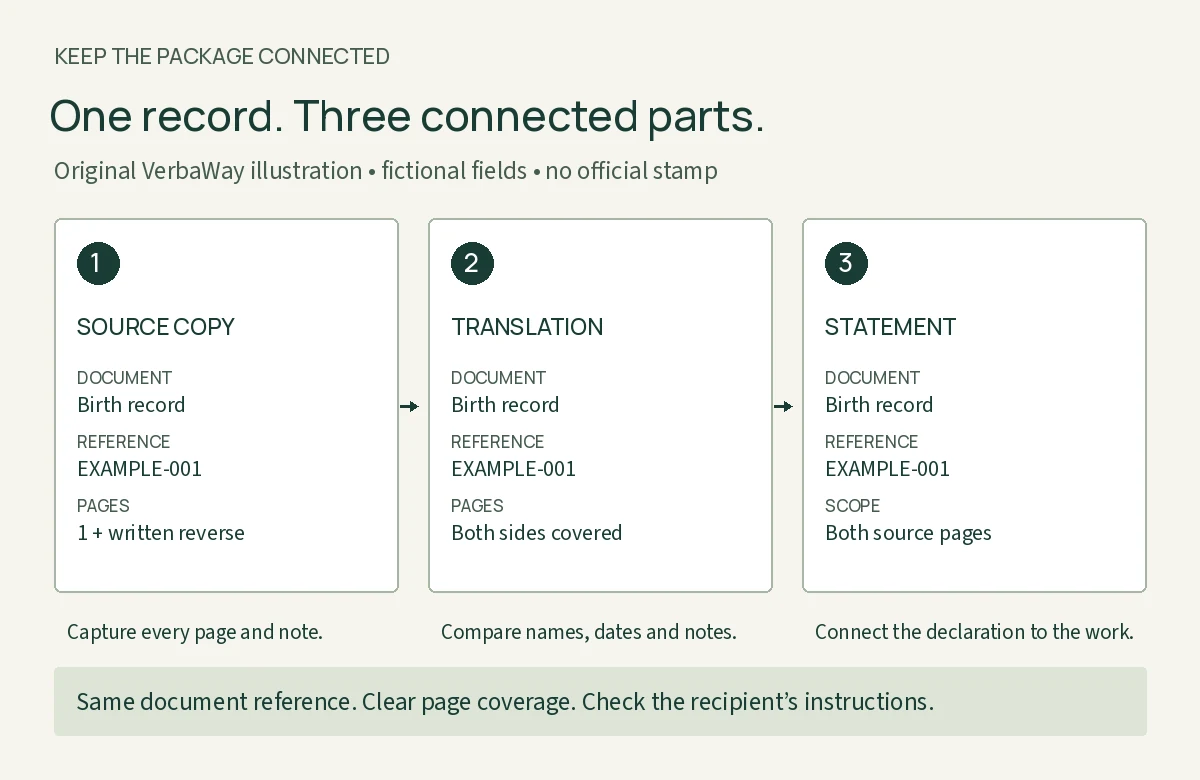
| Package part | The example to verify |
|---|---|
| Source copy | The front and written reverse are both readable. |
| Translation | Both sides belong to EXAMPLE-001 and their text is accounted for. |
| Statement | Its document reference and declared scope identify that translation. |
If a statement says “one page” while the source has a written reverse, ask what the stated scope covers before sending the package. Use the document-preparation checklist to record the recipient’s actual requirements alongside these practical checks.
Check the translation as well as the statement
A certification page is not a substitute for reviewing the translated document. Check that the correct record was translated, all pages are accounted for, and names, dates, and registration numbers correspond to the source.
Account for each record in a multi-document order
An order reference alone may not show which records a statement covers. Prepare a working inventory that connects each source record to its translation and the statement identifying it. This is a review aid, not a rule that one statement may cover every order: check whether the recipient asks for separate certifications.
The following records are fictional, use the same stated source-to-English direction and extend the EXAMPLE-001 illustration:
| Working record reference | Source coverage to confirm | Certification association to check |
|---|---|---|
| EXAMPLE-001 · birth record | Front and written reverse | The statement or its identified document list includes both sides of this record. |
| EXAMPLE-002 · marriage record | One sheet, with no written reverse in this example | This record is identified separately rather than being assumed to belong to EXAMPLE-001. |
Confirm the actual source and target languages for each record. Different directions or signers need their own competence assessment. Do not attach a generic declaration to another translation just because the language labels or order number match.
Keep corrections and certification on the same version
When the provider corrects a translation, request the corresponding completed package and clarify which version the signer certified. Use a working label such as “revised translation” for your own files, and keep the superseded package apart. A new filename alone does not establish that the statement covers the correction.
For example, suppose a registration number was mistyped on EXAMPLE-002 and the provider sends a replacement translation. Ask: “Does the accompanying certification refer to this corrected version, and has any required signature or date been updated?” This is an illustrative review question, not a prescribed statement or an instruction to change a signed certificate yourself.
Before submission, check:
- The corrected translation is the version you intend to send.
- Its source record and page coverage remain clear.
- The certification accompanies or clearly identifies that version.
- The signer’s role and competence declarations still concern that work.
- Any required signature, date and recipient-specific instructions have been checked with the provider.
Do not edit the final translation after certification and assume the earlier statement still covers it. If another change is needed, return it to the provider for review rather than combining the newest translation with an unexplained old declaration.
Do not confuse a statement with a credential
The American Translators Association distinguishes certification of a translation from professional certification of a translator. Its guidance also describes certification statements as identifying the document and declaring accuracy and completeness. A statement does not establish an unrelated credential, membership, or official appointment. ATA’s explanation of the distinction.
Ask a provider about actual qualifications separately when your institution requires them. Do not add a credential, logo, seal, or registration number to a template unless it truthfully belongs to the signer and applies to the work.
Why the same wording may not work everywhere
For a named-recipient comparison, the Isle of Man Senior or Specialist Worker translation guide checks the Manx statement requirements and the additional credential question for leave-to-remain applications. Confirm the actual recipient and application type before reusing a generic “UKVI certified” label.
GOV.UK’s general translation-certification guidance asks for confirmation of accuracy, the translation date, and the translator’s full name and contact details. Check the specific UK institution for any further requirements. GOV.UK certification guidance.
For an overseas organisation’s letter under the UK Religious Worker route, use the letter translation and handoff checks to distinguish an issuer correction from a translation correction. Confirm that route’s applicable instructions rather than treating the USCIS illustration above as a UK form.
A request for an affidavit or notarial act is also separate from simply signing a translation statement. The relevant authority and jurisdiction determine that process. Read certified versus notarized translation before treating these words as interchangeable.
For a recipient-specific attachment example, our CREST registration-evidence checklist shows why a completed English application form does not replace its required foreign-language source and translation. Follow that application’s own instructions rather than transferring this illustrative statement to it.
Common questions
Can I use a sample certification page from another order? A statement needs to correspond to the actual translation and signer. A sample can illustrate the format, but it should not be repurposed as evidence that somebody certified different work.
Can one statement cover several translated records? Check the receiving institution’s instructions. If the proposed arrangement covers several records, ask the provider how each document, language direction, page scope and final version is identified; a shared order number does not answer all those questions.
Does the certification have to be on a separate page? Follow the recipient’s instructions. The key practical check is that the declaration is clearly associated with the translation; do not assume a layout requirement absent from the actual instructions.
Does notarizing this statement confirm the translation’s accuracy? A notarial act has its own purpose and rules. It should not be treated as a separate linguistic review by the notary. Confirm what act your institution requests.
The certified translation service overview sets out the scope and delivery questions to discuss for a quote.
Before commissioning your documents, compare the full USCIS preparation checklist with the instructions for your filing. You can request a quote with those instructions and ask which certification arrangements apply to the work. The receiving authority remains responsible for assessing the submitted evidence.
Sources checked on . The cited requirements apply to the named institutions and processes. Recheck your recipient’s current instructions.